Signs Your Child May Need Early Orthodontic Care
Posted on 1/12/2026 by SRD Tuscumbia |
 Recognizing the signs your child may need orthodontic care early can save your family years of more complicated treatment later, and our Tuscumbia, AL team often spots the first clues during routine pediatric visits. The American Association of Orthodontists recommends that every child have an orthodontic evaluation by age 7. That timing surprises a lot of parents, because most kids still have a mouth full of baby teeth at that age. The reason it works is simple: by 7, enough adult teeth have erupted, and the jaw is still developing enough, that a clinician can spot issues that are far easier to correct now than later. Recognizing the signs your child may need orthodontic care early can save your family years of more complicated treatment later, and our Tuscumbia, AL team often spots the first clues during routine pediatric visits. The American Association of Orthodontists recommends that every child have an orthodontic evaluation by age 7. That timing surprises a lot of parents, because most kids still have a mouth full of baby teeth at that age. The reason it works is simple: by 7, enough adult teeth have erupted, and the jaw is still developing enough, that a clinician can spot issues that are far easier to correct now than later.
An evaluation does not automatically mean braces or any active treatment. Sometimes it just means we monitor your child’s development at regular intervals. This article walks through the signs parents should watch for, what the first evaluation looks like, and the difference between early intervention (Phase 1) and full orthodontic treatment (Phase 2). For broader context on how we care for kids in our practice, visit our dentistry for kids page.
On This Page
Why Age 7 Is the Recommended Evaluation Age
By the time most children turn 7, the first adult molars have come in and the front incisors are usually starting to erupt. That mix of baby teeth and permanent teeth gives an orthodontically trained eye a window into how the bite is developing, whether there is enough space for the rest of the adult teeth, and whether the upper and lower jaws are growing in proportion. Because the bones of the face and mouth are still growing, certain issues can be guided into better positions in a way that is no longer possible once a child finishes growing.
An age-7 evaluation does not mean treatment at age 7. For most kids, the answer is that everything is on track and we will check again in a year or two. For a smaller group, early intervention can prevent more involved treatment later, and the team will explain exactly what they see and why timing matters.
Signs Parents Should Watch For
You do not need to be a dentist to spot the early warning signs. Watch for these in everyday life:
| • |
Early or late loss of baby teeth – Losing teeth much earlier or later than peers can affect how permanent teeth come in
|
| • |
Crowding or unusual spacing – Visibly crooked teeth or noticeable gaps once the permanent teeth start arriving
|
| • |
Difficulty chewing or biting – Avoiding certain foods, chewing on only one side, or visible struggle with normal foods
|
| • |
Mouth breathing – Habitual breathing through the mouth rather than the nose, especially during sleep
|
| • |
Persistent thumb-sucking past age 5 – This can shift the front teeth and affect jaw development
|
| • |
Teeth that do not meet properly – The upper teeth covering too much or too little of the lower teeth when biting down
|
| • |
Jaws that shift or make sounds – A click, pop, or sideways shift when the mouth opens or closes
|
| • |
Speech issues – Lisps or other speech patterns that may relate to tooth or jaw position |
Any single sign on its own may not require treatment, but a combination is a strong reason to schedule an evaluation. Often the things parents notice at home are confirmed and clarified at an in-office dental exam.
Phase 1 vs. Phase 2 Treatment
 Pediatric orthodontics is often divided into two phases, and not every child needs both. Pediatric orthodontics is often divided into two phases, and not every child needs both.
Phase 1, sometimes called interceptive orthodontics, typically happens between roughly ages 7 and 10 while the child still has a mix of baby and permanent teeth. The goal here is not a perfectly straight smile. It is to address specific issues, such as a narrow upper jaw, a crossbite, severe crowding, or habits that are affecting development. Treatment in this phase might involve a palatal expander, partial braces, a space maintainer, or a custom appliance. It is usually shorter than full braces, often less than a year.
Phase 2 is what most people picture when they think of braces or clear aligners: comprehensive treatment after most of the adult teeth have come in, usually starting between ages 11 and 14. For some kids, Phase 1 reduces what Phase 2 needs to accomplish, and a few children do not need Phase 2 at all. Many teens and adults are also good candidates for Invisalign as an alternative to traditional braces.
The decision about whether to recommend Phase 1, wait and watch, or skip directly to Phase 2 later is highly individual. There is no one-size-fits-all rule, which is why early evaluation matters so much.
What Happens at the First Orthodontic Evaluation
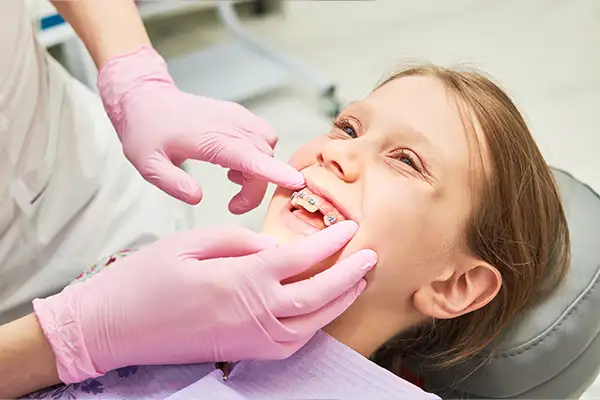 A first evaluation is a low-stress, low-commitment visit. The clinician examines your child’s teeth, bite, and jaw alignment, often takes a few digital images, and may take impressions or scans if it would help build a complete picture. You will get an honest assessment of what looks healthy, what may need monitoring, and whether any early intervention is worth considering. A first evaluation is a low-stress, low-commitment visit. The clinician examines your child’s teeth, bite, and jaw alignment, often takes a few digital images, and may take impressions or scans if it would help build a complete picture. You will get an honest assessment of what looks healthy, what may need monitoring, and whether any early intervention is worth considering.
Many parents leave the first visit feeling relieved. The most common outcome is “all looks good, see you in a year.” When treatment is recommended, the team explains the why, the options, the rough timeline, and what daily life will look like during treatment. Bring any questions you have, including ones about cost, insurance, and how appointments will fit into school and sports schedules.
Caring for Your Child’s Smile in Tuscumbia
Early evaluation is one of the simplest, lowest-risk things you can do for your child’s long-term smile. If you have noticed any of the signs above, or if your child is approaching age 7 and has not yet had an orthodontic evaluation, our team at Singing River Dentistry and our kid-focused Treehouse Children’s Dentistry locations across the Shoals are glad to take a careful look. Call 256-383-0377 or visit our Tuscumbia dental practice to schedule a family dentistry visit.
Frequently Asked Questions
Is age 7 really too early for an orthodontic evaluation?
No. Age 7 is the age the American Association of Orthodontists recommends for a first evaluation, not for treatment. Most kids who are evaluated at 7 are simply monitored. The point is to catch the small number of issues that benefit from early intervention before growth makes them harder to address.
Does my child need a referral to see an orthodontist?
In most cases, no. You can schedule an orthodontic evaluation directly. Many general and family dentists also perform initial orthodontic screenings during routine visits and refer to a specialist when warranted.
Will my child definitely need braces after Phase 1 treatment?
Not always, but often yes. Phase 1 addresses specific developmental issues; Phase 2 (full braces or clear aligners) typically follows once the rest of the permanent teeth are in. In some cases Phase 1 reduces or even eliminates the need for Phase 2.
Can I just wait until all my child’s adult teeth are in?
For many kids, yes, that is appropriate. But for a smaller group, waiting means missing the developmental window when growth can be guided. The only way to know which category your child falls into is an evaluation.
Are mouth breathing and thumb-sucking really orthodontic issues?
They can be. Habitual mouth breathing can affect how the jaws and palate develop. Thumb-sucking past about age 5 can shift the front teeth and affect bite alignment. Both are common topics in early orthodontic evaluations.
How often should we follow up after the first evaluation?
If no treatment is needed, most kids return for a recheck every 6 to 12 months, often aligned with their regular dental cleanings. If active treatment is recommended, the schedule depends on the appliance or plan.
|
|

